AniOntology AI: Ontology-Driven Anime Knowledge Graph with Explainable Recommendations
AniOntology AI models the anime ecosystem as a semantic knowledge graph. Metadata from
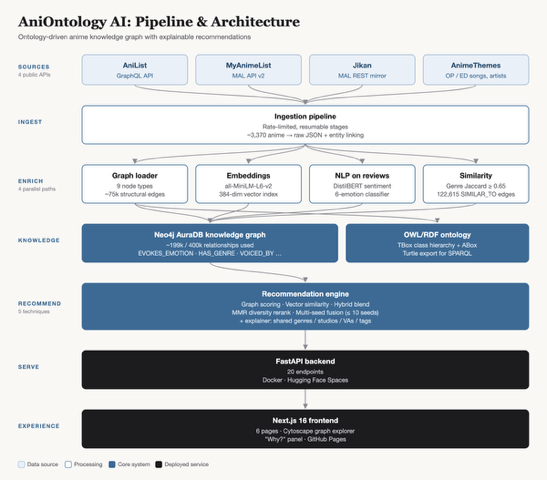
AniList, MAL, Jikan, and AnimeThemes is ingested and loaded into Neo4j, then formalised
into a proper OWL/RDF ontology — a TBox class hierarchy (Anime ⊆ CreativeWork,
emotion/genre taxonomies) plus an ABox builder that serialises instance assertions from the
graph into Turtle, so the dataset can be reasoned over with standard semantic web tooling
(SPARQL, Protégé, OWL reasoners) rather than just queried.
On top of the graph, all-MiniLM-L6-v2 sentence embeddings and HuggingFace
sentiment/emotion models (distilbert-sst2 + a 6-emotion classifier) derive
EVOKES_EMOTION edges from review text. A FastAPI backend exposes 20 endpoints —
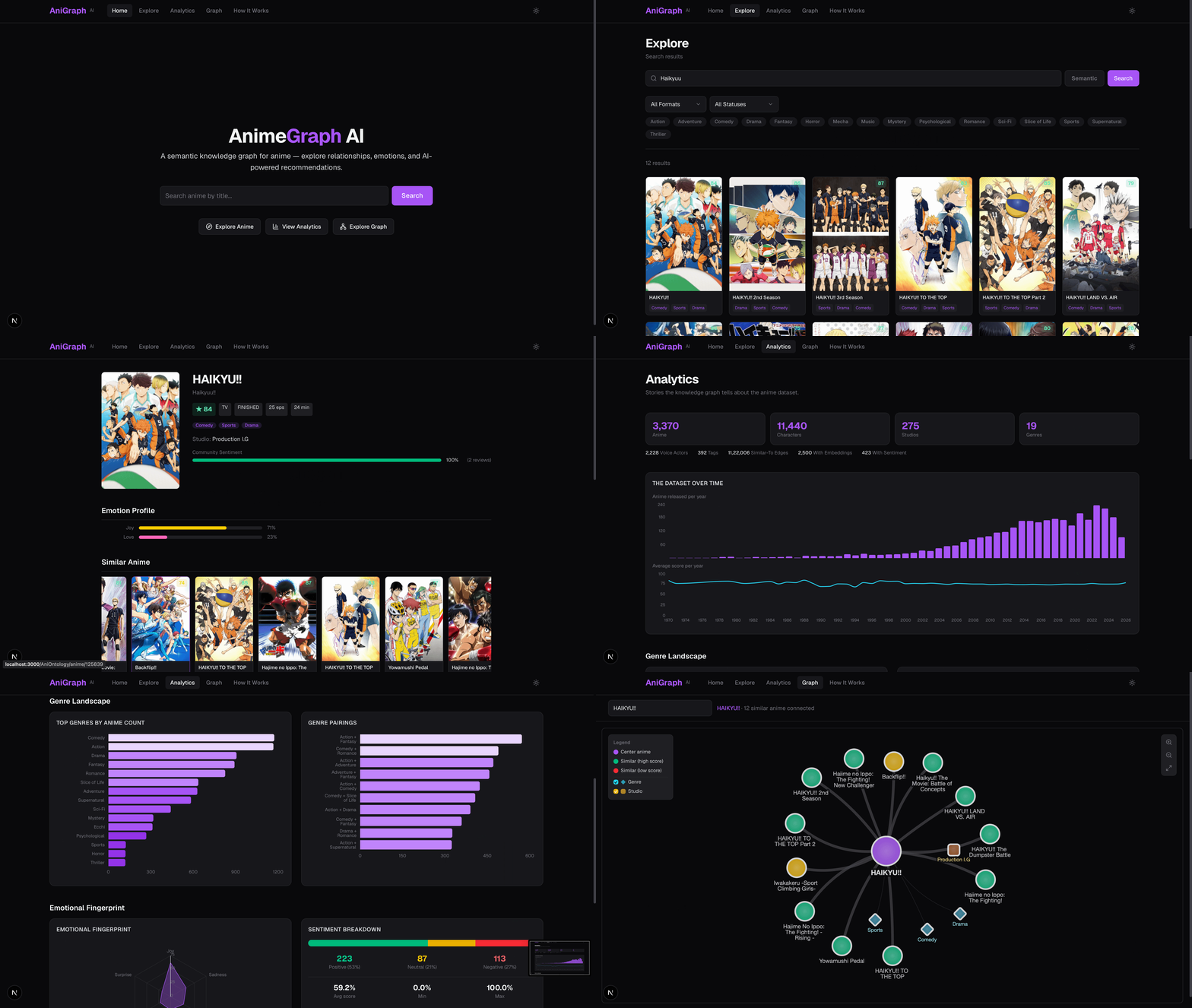
search, analytics, ontology introspection, and recommendations — consumed by a Next.js 16
frontend with six pages, including a Cytoscape.js graph explorer for visually navigating the
knowledge graph and a "Why?" panel that explains each recommendation.
The recommendation engine implements five Netflix-inspired techniques: multi-signal graph traversal scoring (genre/studio/voice-actor/tag/emotion overlap), vector similarity over the 384-dim embeddings via Neo4j's native vector index, hybrid scoring that blends both with a sentiment quality boost and popularity penalty, MMR diversity reranking to reduce genre repetition, and multi-seed session-aware fusion across up to 10 seed anime.
SIMILAR_TO
edges precomputed at a 0.65 genre-Jaccard threshold — deliberately stricter than the code
default of 0.25 (which would produce ~1.1M edges) to stay under Neo4j AuraDB Free's
400,000-relationship cap, leaving comfortable headroom for the ~75k structural and ~1k
emotion edges. Backend on Hugging Face Spaces (Docker), frontend on GitHub Pages.
Five-technique recommendation engine (graph scoring, vector similarity, hybrid, MMR diversity, multi-seed fusion) with a live explainability panel surfacing the shared genres, studios, voice actors, and tags behind every recommendation.